Wednesday, July 27, 2016

The Presidents Club: Inside the World's Most Exclusive Fraternity by Nancy Gibbs, Michael Duffy


5 of 5 stars  *****

This reader is thankful for the gift that is The President's Club: Inside the World's Most Exclusive Fraternity. Nancy Gibbs, along with Michael Duffy, compile information about past and present Presidents not known by the average citizen. Starting with Truman and Hoover and ending with Obama and Bush, W., the President's club explores its significance during modern times utilizing all living Presidents. This select population are the only ones capable of understanding what the existing President is going through, even though they are not privy to confidential circumstances unique to every term. 

The club is in existence from the inception of the United States' birth. Washington has the sole characteristic of being the lone member, at first, but he has future Presidents with whom to confer, confide, and console in John Adams and Thomas Jefferson. Strong personalities usually give way to the need of sound advice when in that most high executive office. Democrats enlist Republicans and vice-a-versa to resolve issues not faced by the ordinary human being. The office becomes greater than the person.

A respect for those whom one knows little but from historical accounts and media headlines, inculcates itself into those who pick up this book and delve into its refreshing and astonishing pages. This reader is in a state of amazement after finishing this revealing non-fiction of a subject most interesting, the politics and human nature of those who accept the daunting task, President of the United States.

Wednesday, July 13, 2016

You Are What You Love: The Spiritual Power of Habit by James K.A. Smith (Goodreads Author), Claton Butcher (Narrator)


4 of 5 stars ****

This audiobook synchronizes with my other studies well. You Are What You Love: The Spiritual Power of Habit influences my daily activities, including prayers. I examine how much time I spend on pursuing my own personal desires during any given day as well as any daily rituals that become my habit. I evaluate whether or not my habits serve my efforts in achieving those desires. More importantly, James K. A. Smith's book makes me question the righteousness of my goals. The truth is, my habits are more self-serving than I am comfortable admitting. This excerpt from the book illustrates the lesson I use in my introspection, "Be careful what you worship; it will shape what you want and, therefore, what you make and how you work." 

The worship aspect of my life truly shapes who I am in that it reveals what and who I love. Smith refers to Proverbs 4:23 to eloquently express this, "Above all else, guard your heart for everything you do flows from it." This idea encompasses my total being, not just my intelligence. The author further explains why worship is natural drawing upon 1 John 4:19, "We love because He first loved us." Then Smith uses Aristotle's probing thoughts on this subject explaining that he who is pushed into the Universe out of love has a yearning to seek the source of that love. God is love. 1 John 4:8 asserts, "Whoever does not love does not know God, because God is love." God is always pulling us back toward Him.

Intelligence seems to obscure the way, at times, on that path back to the Creator. Following Christ Jesus assures me of remaining on the proper course. Christ says in the Gospel of John, "I am the Way and the Truth and the Life." Jesus, the second person in the Trinity and, therefore, God, simply states that He is the way to eternal life by sincerely accepting Him as the one who first loved us. His dying on the cross for our sins demonstrates that love. The next sentence of John 14:6 is more explicit, "No one comes to the Father except through me."

Another valuable lesson from this book is the power of habit. Since we are much more than thinking machines, we need to engage our feelings and inspiration in healthy, desirable behaviors that keep us on track toward our goals. If that goal is to ultimately return to that source of love for all eternity, habits that keep us on the enlightened path are necessary. Knowledge, itself, cannot change our behavior. Our goal should be to do what God desires of us.

You Are What You Love: The Spiritual Power of Habit continues with the subjects of teaching how to love and discipleship. A lesson absorbs into the mind but application of that lesson must be put through the body. The desire to carry out the behavior is not instantaneous. In fact, thinking counters the culture of impulse, according to Smith. Correct repetition of a behavior can make it an action that requires little thought. A habit is born. Analysis of my habits and my goals tells me if these two important life lessons are aligned or not. It also tells me if I am unconsciously undermining myself. If so, I am frustrated and anxious. If not, I am in a state of peace. St. Augustine expresses this relationship in his Confessions, "You have made us for yourself and our heart is restless until it rests in you."

Thursday, June 16, 2016

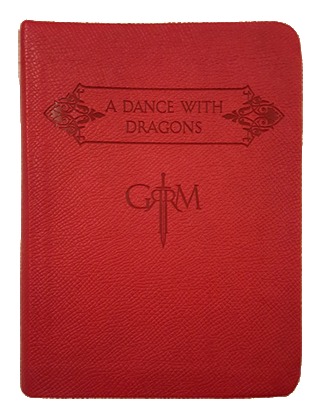
A Dance with Dragons (A Song of Ice and Fire #5) by George R.R. Martin


5 of 5 stars  *****


In a book that one expects completion or, at least, closure, A Dance with Dragons, instead, ends with more expectation and desire for the tying of loose ends. The only finality in this book is the same as it is in all of George R. R. Martin's Game of Thrones: A Song of Ice and Fire books, the deaths of well developed characters and the demise of kingdoms. The multiple plots unfold simultaneously in different regions of Westeros: The North, The South, and beyond The Wall where it is always cold, frequently snowing, and domain of the Wildlings, the uncivilized Free Folk. 

The scope of this epic tale requires a time overlap between the fourth book, A Feast for Crows, and Martin's fifth book, A Dance with Dragons. Both books begin at the end of the third book, A Storm of Swords. The story is so vast that each book tells the tale of two geographical locations with all of its players and all of their intrigue. This parallel continues midway through A Dance with Dragons before the saga resumes with mention of characters from all regions. The maps in the beginning of this book give the mind's eye a reference to place readers into Martin's fantastic Medieval world. 

George R. R. Martin is a student of history and admits to using the Wars of the Roses, circa 5th century, as an inspiration for his A Song of Ice and Fire series. Certain characters and events are similar to the dynasties who battle one another during this time period. Those battles are historically won and lost between the Yorks and the Lancasters for the throne of England. 

A major and memorable event in the Game of Thrones is the Red Wedding which occurs in this author's imagination and resembles the blood bath that occurs in Scottish history under similar trusts and betrayals. Further connections to reality involve the Wildlings, who are examples of the Scots, the Gaelic people who migrated from Ireland to Scotland in the late 5th century. The Romans built Hadrian's Wall to keep the uncivilized people in the north from coming south. That wall represents the huge wall of ice guarded by the Night's Watch at Castle Black to prevent the Wildlings from migrating south. The Queen across the Water, Daenerys Targaryen, Khaleesi, Daenerys Stormborn, the Unburnt Mother of Dragons, among other names, is said to be a cross between Joan of Arc and Cleopatra.

A Dance with Dragons releases in 2011 with a promise from its author for an additional book in this series, The Winds of Winter.

Sunday, June 5, 2016

The Ocean at the End of the Lane by Neil Gaiman


4 of 5 stars ****

 The story is a flooding flashback of earlier times an adult has when he returns to the neighborhood in which he grew up. These memories emerge around a tragic suicide that release negative, unknown energy into the location in which it occurs. 

The foreshadow of suppressed dark, fearful threats challenge the young boy who needs the comfort and reassurance of a remarkable little girl, Lettie Hempstock. She guides him through crossed boundaries he has yet to imagine.

The marvelous imagination of Neil Gaiman displays in The Ocean at the End of the Lane, a novel that starts, originally, as a short story. Fantasy abounds in the boyhood roots of this author as a pond becomes an ocean and characters are full of magic. The rules of the universe become tools of fiction with extraordinary twists that stretch one's interpretation during this glorious adventure where even time is questionable.

Sunday, May 22, 2016

A Feast for Crows (A Song of Ice and Fire #4) by George R.R. Martin


5 of 5 Stars  *****

Book Four: A Feast for Crows takes the reader on an incredible adventure in many parts of the Game of Thrones: A Song of Ice and Fire world. The book differs in that all of the characters who die in the TV series do not die in this book. The HBO series, on Netflix DVD, exaggerates the relationships between characters in the book making one's demise more dramatic for the television audience. Whether it is the book or the series, the epic tale is fabulous and keeps this fan anticipating every twist and turn in the dynamic plots ongoing in incredible realms. New characters come while beloved characters die. Magic creates an incredible pool of imagination from which to draw. It is not overused. Instead, the deaths of key characters alarm in resolving some issues but expand other adventures for those who are left playing the Game of Thrones.

Wednesday, May 4, 2016

Explore the Bible: Personal Study Guide: Acts 1-12: Spring 2016 by Vance H. Pitman (Editor), Dean Register


5 of 5 stars  *****

Reading the Bible is profound.  Studying sections of its contents with a group of Christians is eye-opening.  A deeper, fuller understanding of events during a time approximately 1500 years ago shed light on today's issues.

Acts is written, most likely, by the physician Luke, author of the third Gospel.  Acts is also evidently written as a sequel to the third Gospel.  The Gospels tell the story of Jesus's life and death.  Acts picks up where Christ ascends on the third day and includes the 40 days He spends with many people, most significantly, the apostles.  This time period also includes His ascension to heaven while leaving the Holy Spirit in His disciples and for all men and women who accept Jesus as Christ.

The purpose of Acts is to inform mankind about the beginning of God's mission, to spread His word to all corners of the world.  This starts with the Holy Spirit in the apostles who form the foundation of His church spreading far and wide - the church being the congregation, not the building.  Paul's story resides in Acts as well.  As a matter of fact, Luke writes in the first person plural when he joins Paul on his mission trips; I becomes we.

The story of the church is not relegated to that era of time.  The story of the people, places, persecutions, and persistence is being written today as it was then.  The Book of Acts: 1-12, ends with the two year imprisonment of the apostle Peter in Rome and his release by an angel right under the noses of the guards stationed there to assure his imprisonment.  Peter responds to the call from God and is guided to safety to influence many more before he meets his eventual earthly demise.  Peter's faith and obedience to God demonstrates a common thread that others show in this New Testament book, Acts.

A Call to Christian Patriotism: A Weekly Devotional Essay Series by Howard A. Eyrich


5 of 5 stars  *****


I finish this year-long project a better person, a true Christian, Conservative Patriot.  The format of this devotional series is weekly readings of patriotic, scriptural, and conservative text with an added task.  Every week, I apply myself to the lesson so that my involvement impresses me in a more visceral way.  The book offers suggestions on what to do for my personal tasks.  Many take me out of my comfort zone but I find that necessary for personal growth.  Several times I read the prayer that Dr. Howard A. Eyrich has at the end of his short chapters.  In the beginning, I talk to my state's Representative about the theme of this book, preparing individuals to be educated, involved, citizens of the government and devout, humble followers of Jesus Christ.  This book also teaches the importance of connectedness.  I share this devotional with a 9/12 group that meets monthly and a Christian Men's Ministry that meets weekly.